Vital Guard
Close the loop on undisclosed incidental findings
AI flags documented-but-uncommunicated findings, then closes the loop with auditable, asynchronous patient outreach.
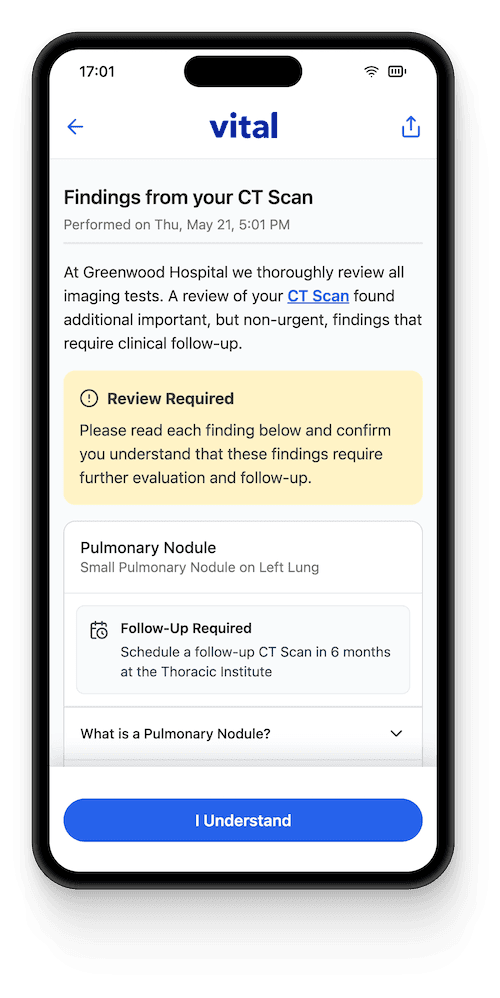
Review Required
CT in 6 monthsThoracic Institute
What is a Nodule?
I Understand
95%
Accuracy Across Modalities
+5
FTEs Saved vs. Manual
+$750k
New Radiology Follow-Ups
Protecting patients and their doctors
Vital Guard™ improves clinical outcomes; solves a key communication gap; decreases malpractice exposure; and generates downstream revenue for your facility.
Incidental radiology findings are extremely common in the hospital, ED, and urgent care. Up to 31% of acute care imaging studies contain an incidental finding. Despite the prevalence, most of these findings are not disclosed to patients. Our studies show 3 in every 100 patients will leave your facility with an actionable incidental finding not having been told.
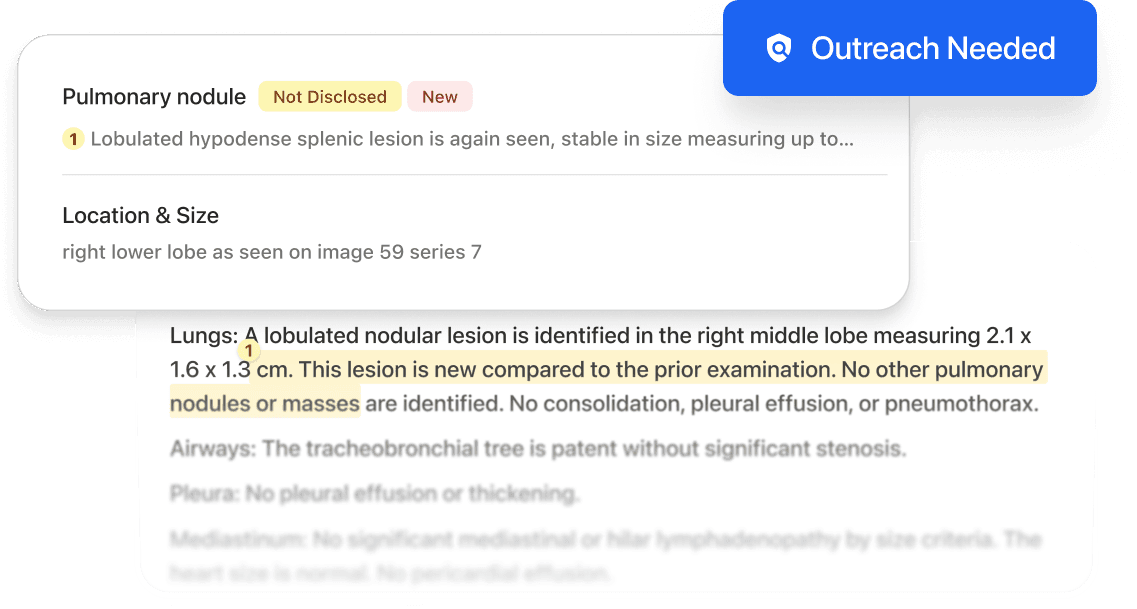
Vital Guard™ is an EHR-connected solution that reads clinical documentation and radiology reports to identify when there is a gap in communication, disclosure, or follow-up for an incidental finding.
For lower-priority findings, patients receive an SMS with the finding, follow-up info and educational material. For more critical findings, patients are primed to receive a phone call from a provider. That means less unanswered calls, fewer voicemails, and less time on the phone.
Identify all the incidental findings with advanced AI
AI automatically generates high priority worklists containing incidental findings that were not communicated during the clinical encounter:
- Neoplasms (cancerous or precancerous lesions) including: nodules, masses, osteolytic lesions, enlarged lymph nodes, bladder wall thickening or irregularities, liver lesions, and complex cysts
- Cardiovascular and peripheral vascular disease, aneurysms, osteoporosis, hepatic steatosis, portal hypertension, and other non-acute but important findings.
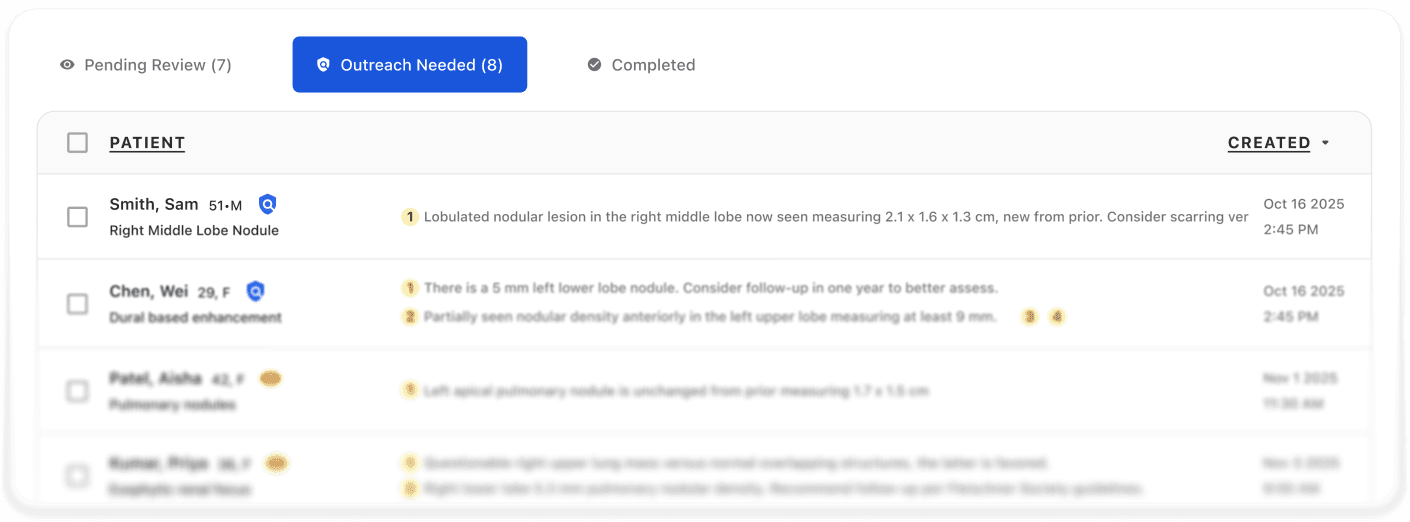
Prioritized worklists
Easily monitor and intervene on an entire health system's incidental findings from a single screen in a fraction of the time. Filter out known, unchanged and disclosed findings to focus on the most critical ones according to ACR guidelines.
Simple SMS disclosure to patients
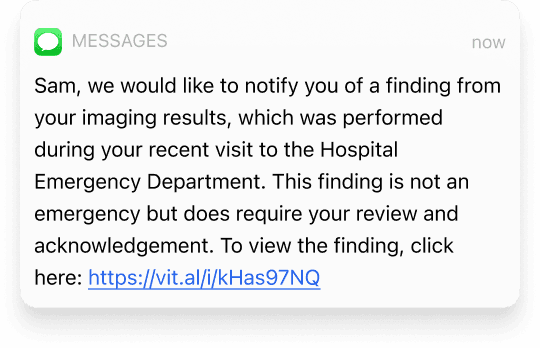
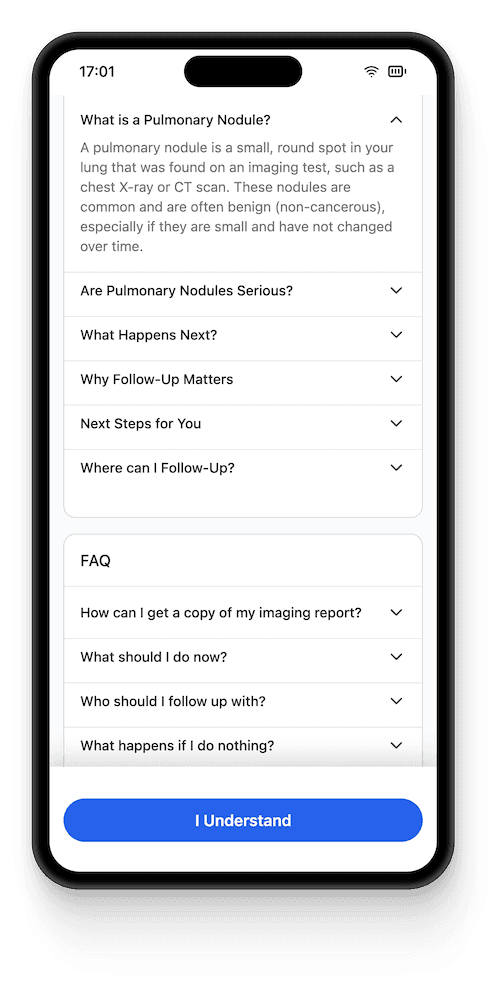
Close the communication loop with simple SMS-based messaging to patients. Patients receive education on their finding, how and where to get follow-up imaging, and then acknowledge their understanding to release liability.
Risks of not using Vital Guard
Without Vital Guard, the risk of malpractice lawsuits is high. Here are two case studies of patients who died as a result of undisclosed incidental findings.
Illinois Woman, 79 ($2,500,000 Settlement)
A 79-year-old woman went to the ER after a fall at church. She was treated for soft tissue injuries and had a chest X-ray done before being discharged. One and a half years later, she returned to the ER with a severe cough.
The doctor determined her symptoms were caused by a mass in her right lung that had grown since her last X-ray during the fall visit. She was diagnosed with Stage IV lung cancer that had spread to her lymph nodes and passed away shortly after.
Her family alleged the mass should have been communicated at the time it was detected during her emergency room visit.
Ohio Woman, 70 (Settlement Undisclosed)
A 70-year-old woman was admitted one night to a hospital ED with complaints of severe headache. A head CT without contrast was interpreted by an off-site radiologist as normal. The following morning, the hospital radiologist rendered a formal interpretation that concluded, "probably normal CT, but because of a questionable density in the area of the anterior cerebral artery, CT scan with infusion is recommended."
The radiologist made no effort to directly communicate the findings to an ED physician. Fifteen months later, the patient was admitted to the same hospital ED after having collapsed at home. CT studies showed a hemorrhaging, ruptured anterior cerebral artery aneurysm. The patient died 1 hour later.
A malpractice lawsuit was filed against the radiologist, ED physician and hospital. A settlement was eventually negotiated, terms of which were not released.
With Vital Guard
With Vital Guard, the risk of malpractice lawsuits is significantly reduced. Here are two reports from actual radiologists using Vital Guard.
Patricia, 73 (Made aware of aneurysm in time)
Patricia, 73, had imaging that incidentally revealed a thoracic aortic aneurysm. When I contacted her, she already had an upcoming appointment with a cardiothoracic surgeon for management of her known valvular heart disease. Yet, she was unaware of the aneurysm. This presented a perfect opportunity for her to discuss the incidental finding during her scheduled visit.
I explained the importance of monitoring the aneurysm and encouraged her to bring it up with the specialist. She expressed gratitude for this new awareness, adding to her preparation for the appointment.
This common scenario illustrates how our program enhances, rather than duplicates, ongoing specialty care by empowering patients with important information.
Marcus, 54 (Messaging Platform Success)
Marcus, a 54-year-old man, was seen in the ED for back pain with pain radiating down his right leg. A CT scan revealed an incidental left adrenal mass noted as an incidental finding. The mass was communicated in the body of the report and via secure message, but outreach required follow-up context to ensure the finding was understood and acted upon.
Our AI-assisted workflow flagged the incidental adrenal lesion and prompted outreach.
An initial secure message was sent on Dec 16th. Our systems showed the patient had viewed the message. A second contact attempt was made by phone on Dec 18th. I spoke with Marcus to review the significance of the finding and recommended follow-up. He was appreciative of the call, confirmed he had viewed the secure message. As a result, he reported he had already contacted his primary care physician and been referred to endocrinology for consultation and monitoring.
This case highlights how important incidental findings can be overlooked without active follow-up—and how a structured communication program helps patients receive timely evaluation and care.