Published research makes a strong case that ED experience is driven by communication and operational flow. Vital's partner network gives us a second, independent test of that case: roughly 310,000 real ED visits across three health systems, two survey vendors, and both adult and pediatric populations. Here's what held up.
Length of stay predicts experience on two different surveys
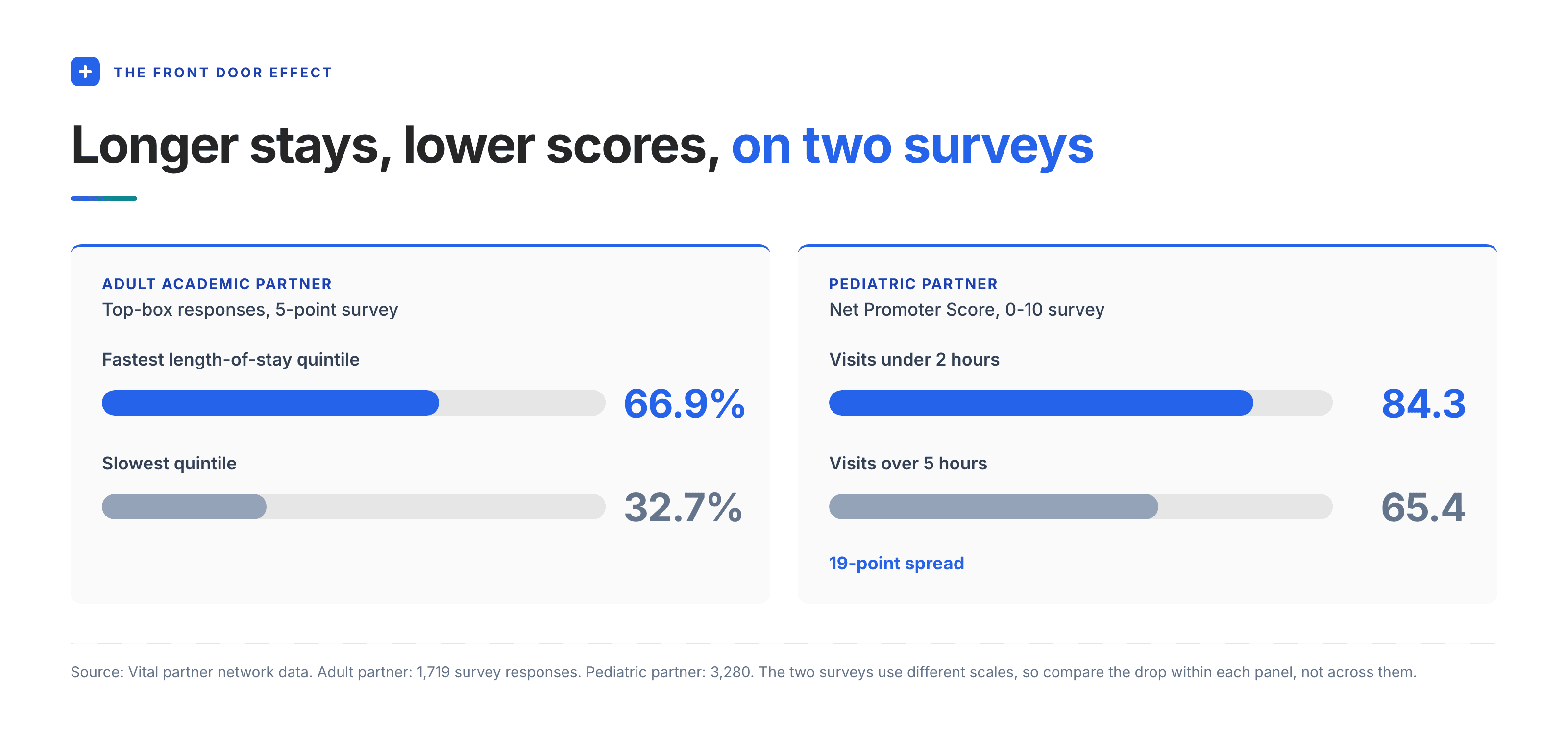
At an adult academic partner, top-box experience responses fell from 66.9% in the fastest length-of-stay quintile to 32.7% in the slowest. At a pediatric partner, Net Promoter Score was 84.3 for visits under two hours and 65.4 for visits over five hours, a 19-point spread. That's the same relationship in two age groups on two instruments, and the replication matters more than either finding alone.
The wait to see a clinician matters most
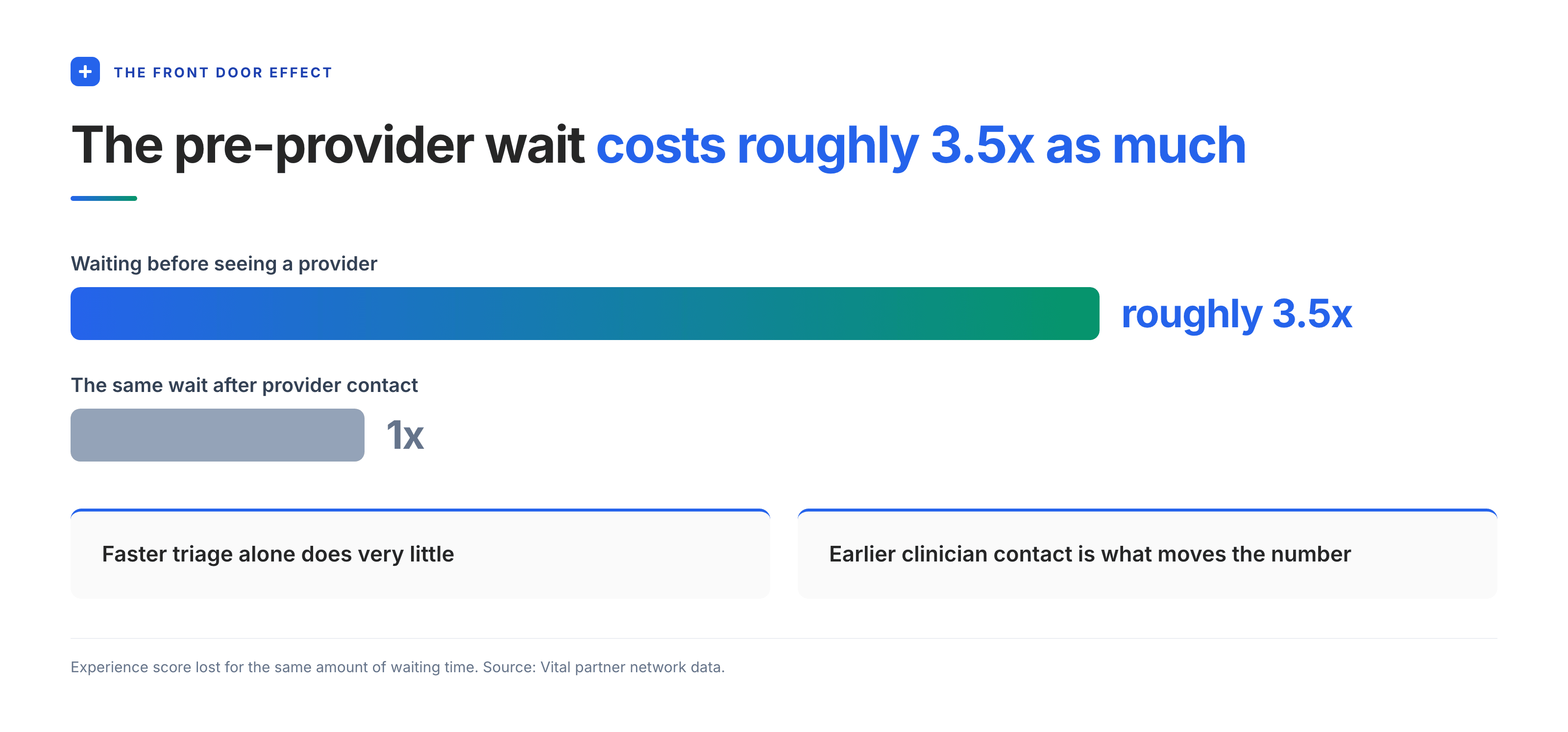
When we broke the wait into parts, time before a patient sees a provider cost roughly 3.5 times as much score as the same amount of time after provider contact. Faster triage alone does very little. Earlier clinician contact is what moves the number, so that's where intervention should focus.
Patients decide early, while there's still time to act
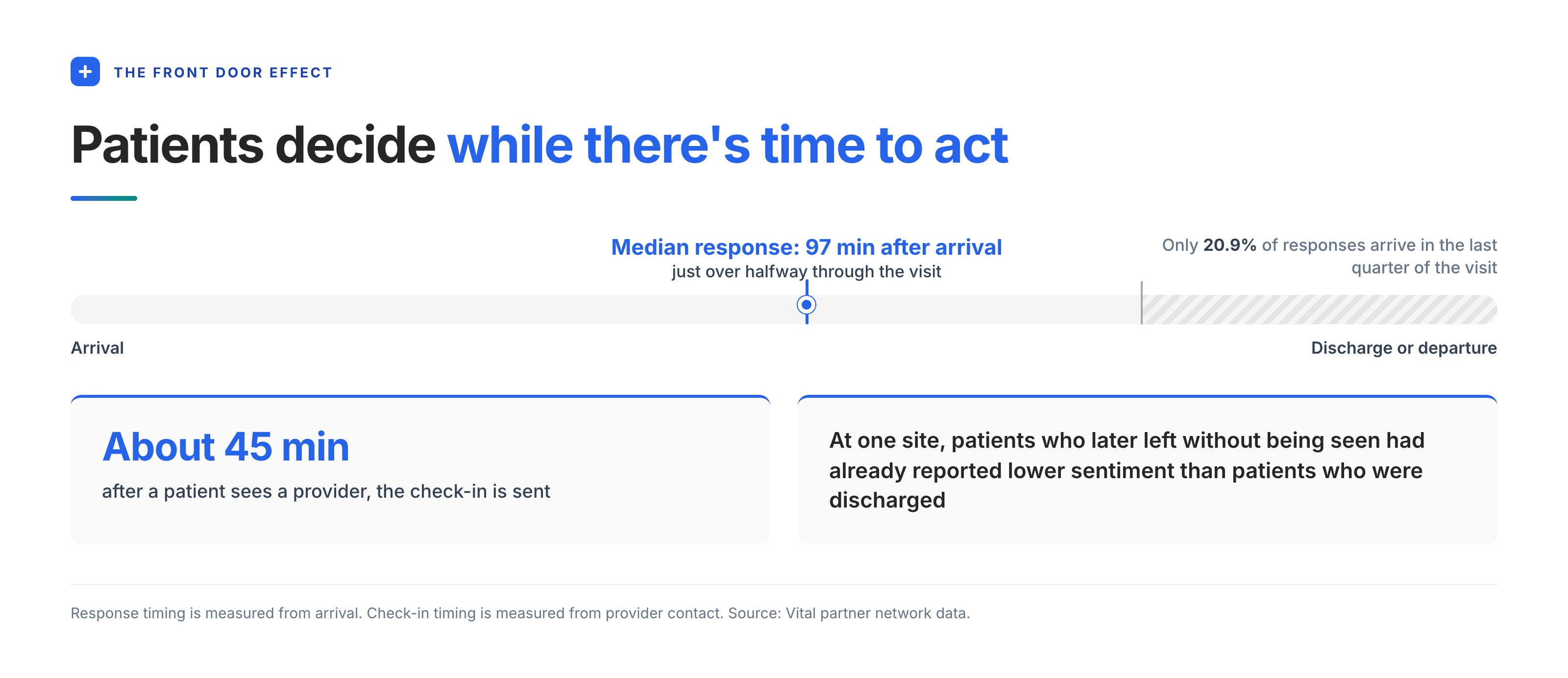
In-visit check-ins are sent around 45 minutes after a patient sees a provider, and the median response arrives just over halfway through the visit. Patients form and report their impression well before they leave, which is what makes a real-time signal useful. At one site, patients who later left without being seen had already reported a meaningfully lower sentiment score than patients who were eventually discharged. That's an early warning, captured while a clinician could still step in.
The demographic pattern holds at scale
The representativeness problem documented in published research shows up here too. White patients were overrepresented among survey responders relative to the ED's actual population, and Medicaid and self-pay patients were undersampled. Once age and sex were accounted for, race was not an independent predictor of score, and the Medicaid effect was marginal at best. The gap many systems see across demographic groups looks substantially explained by who responds to surveys and by age and sex mix, rather than by differential treatment during the visit. That's an operational finding a health system can act on. It shouldn't be presented as an equity conclusion before further review.
The most valuable patients to reach are the ones at risk of leaving
The patients most likely to become detractors or walk out (younger, male, uninsured or on Medicaid, already waiting longest) were unlikely to be top-box responders under any conditions. Reaching them before a disposition decision is made is mostly about their safety. Patients who leave before treatment is complete have a documented higher risk of return visits, hospitalization, and worse outcomes. Discharges against medical advice carry a distinct and serious litigation risk. A tool that flags rising walkout risk in real time catches the patient most likely to come back sicker, while a clinician is still in the room to change the outcome.
That makes this a clinical and safety case, and it happens to improve the score too.