Ask a hospital leadership team why the emergency department isn't a top-three capital priority, and you'll often hear a version of the same answer: we aren't rated or paid on ED experience specifically, so why treat it differently from any other cost center? It's a fair question, and it has a clear answer.
The ED is already inside the number you're rated on
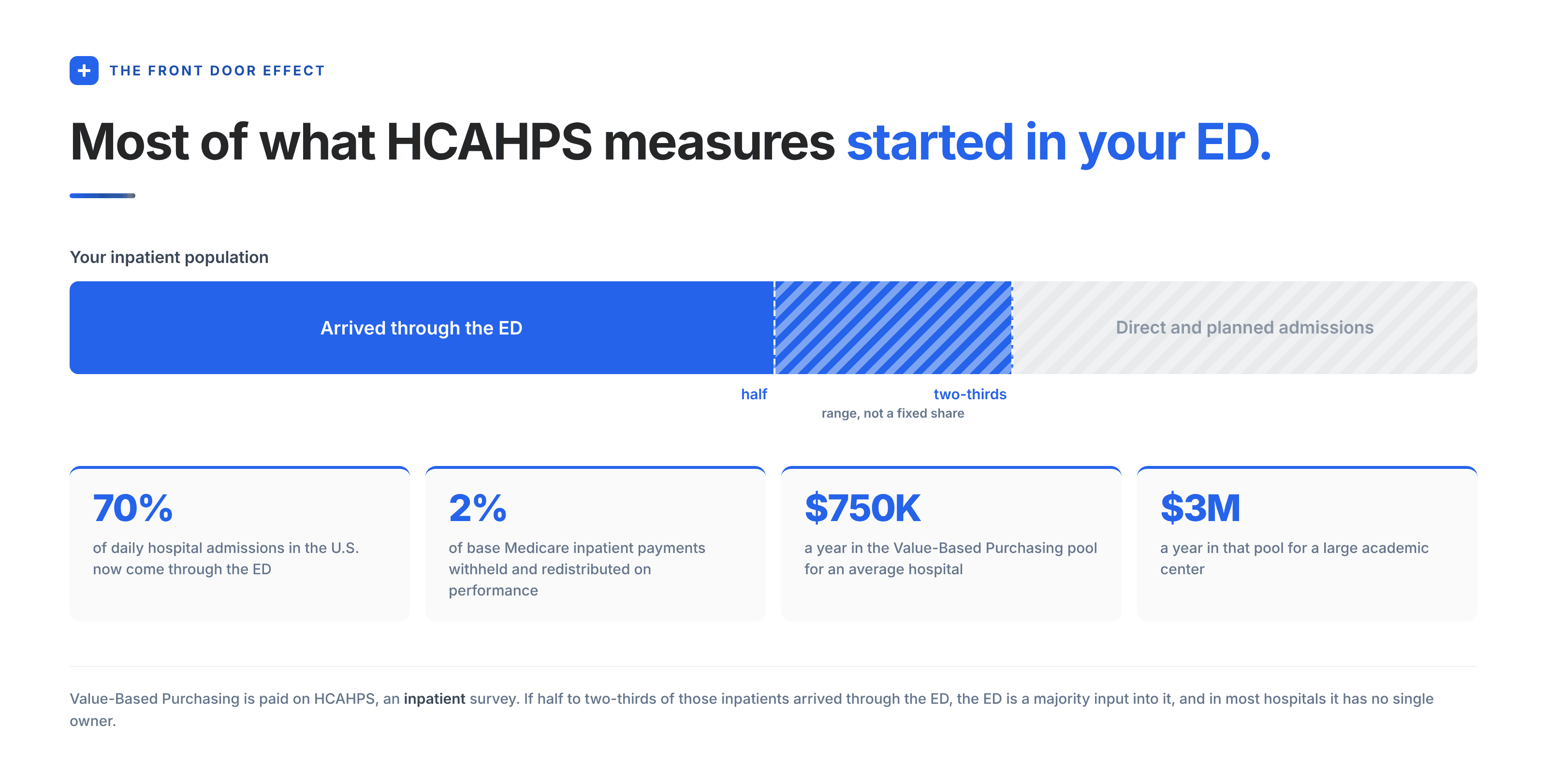
Roughly 70% of daily hospital admissions in the United States now come through the ED. HCAHPS, the survey tied to Hospital Value-Based Purchasing dollars, explicitly adjusts for ED-admission status because CMS has measured that this one fact about a patient's visit moves hospital-level scores. Value-Based Purchasing withholds 2% of every participating hospital's base Medicare inpatient payments and redistributes that pool, funding roughly $1.9 billion in incentive payments a year. For an average hospital, that's around $750,000 a year. For a large academic center, it's closer to $3 million. If ED-admitted patients make up half to two-thirds of your inpatient population, the ED is a majority input into that number, and right now it likely has no single owner.
Reputation has no sampling filter
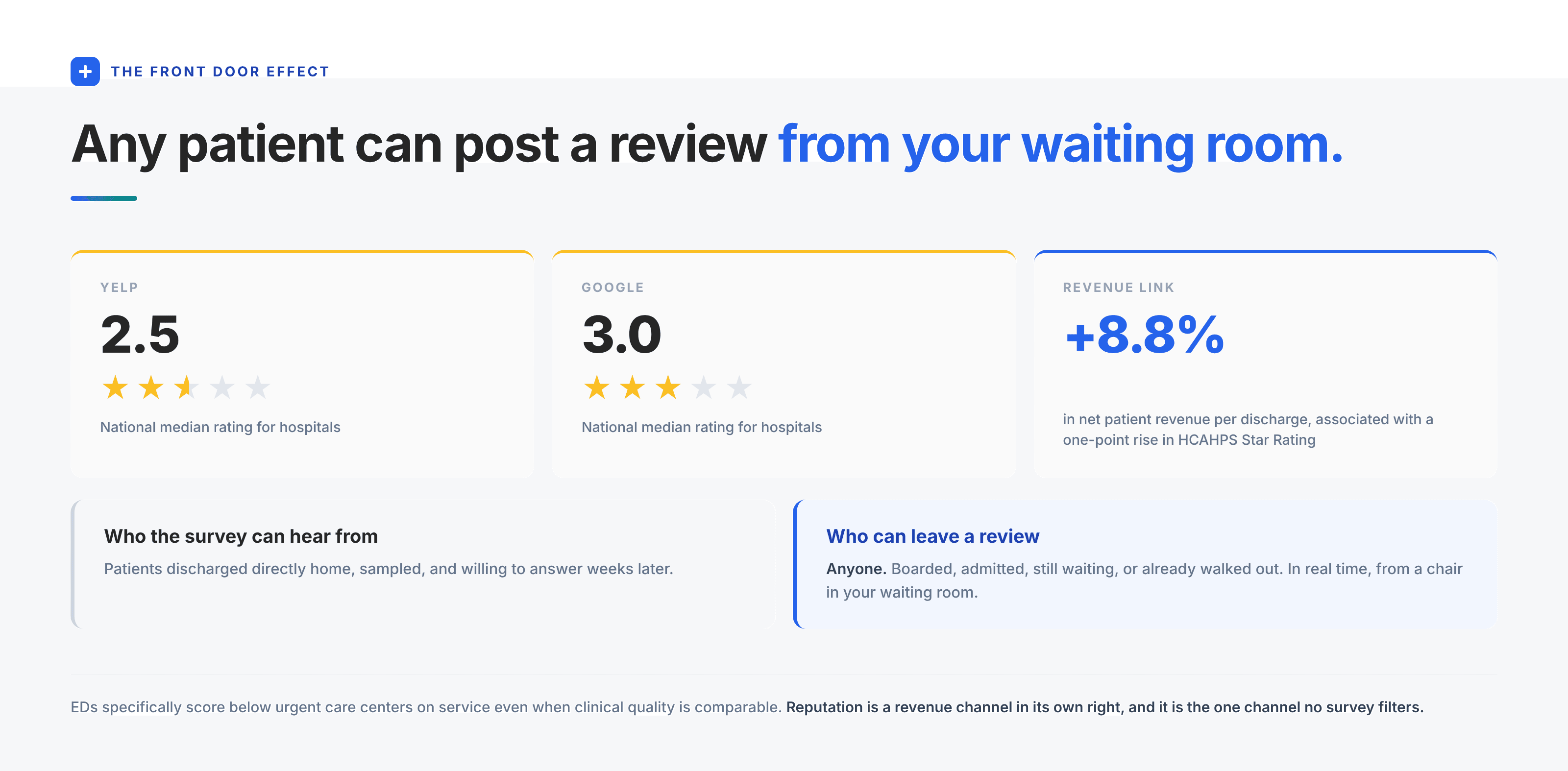
Online reviews get around every exclusion built into formal surveys. A boarded or frustrated patient can post from the waiting room in real time. National baselines are already low, with median ratings around 2.5 stars on Yelp and 3 on Google, and EDs specifically score below urgent care centers on service even when clinical quality is comparable. A one-point rise in HCAHPS star rating is associated with an 8.8% increase in net patient revenue per discharge. Reputation is a revenue channel in its own right.
The ED feeds your highest-margin service lines
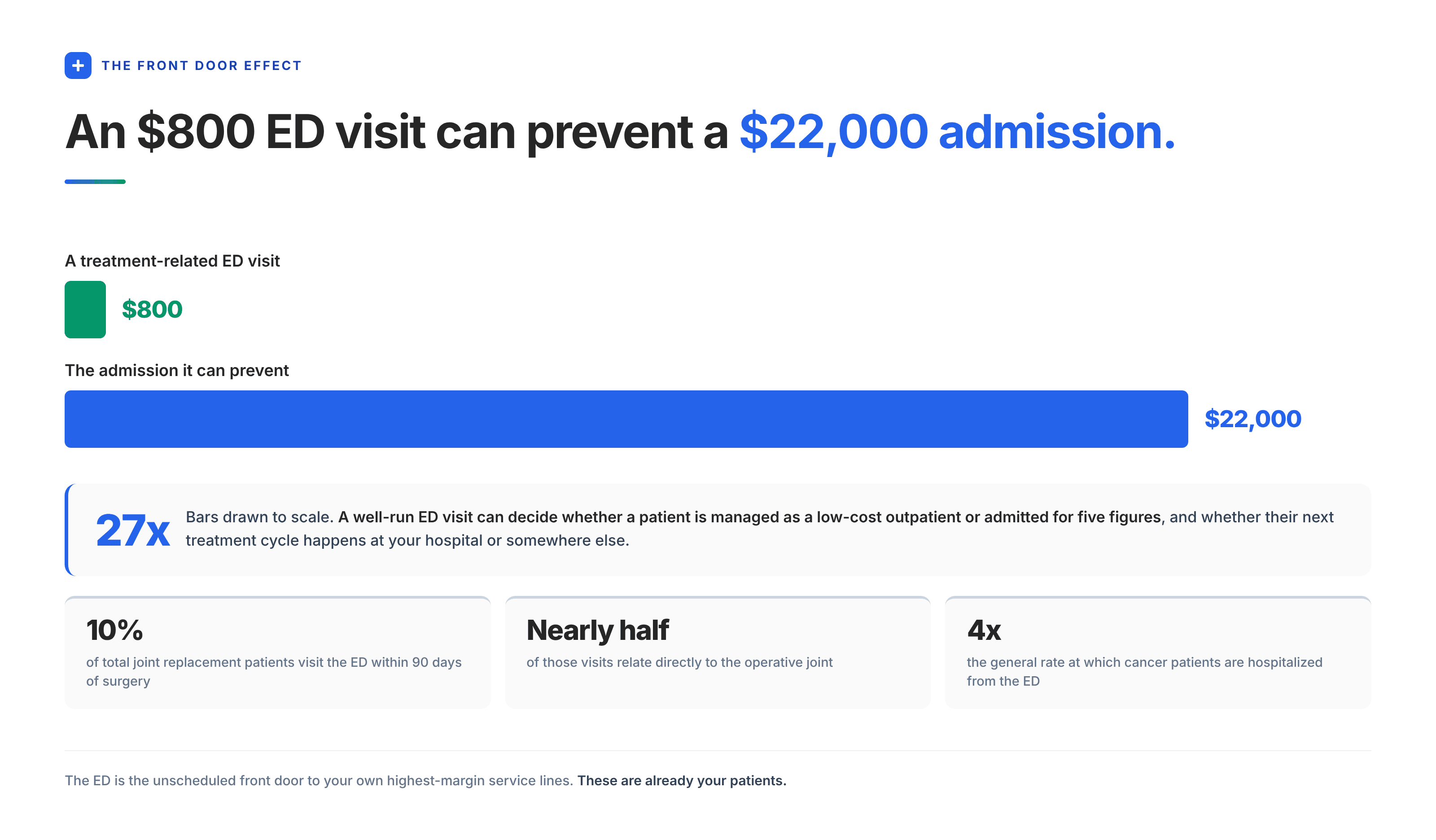
Roughly 10% of total joint replacement patients visit the ED within 90 days of surgery, and nearly half of those visits relate directly to the operative joint. Cancer patients visit the ED at high rates and are hospitalized from it at roughly four times the general rate. A single treatment-related ED visit costs around $800, while the admission that follows can run $22,000. A well-run ED visit can decide whether a patient is managed as a low-cost outpatient or admitted for five figures, and whether their next treatment cycle happens at your hospital or somewhere else.
The complication, and why it's shrinking
Non-ED admissions do generate more revenue per inpatient day than ED admissions, which is part of why boarding persists: in a bed-constrained hospital, admitting more ED patients can mean displacing higher-margin elective cases. That tension is shrinking on its own, though. Elective surgery has been moving to ambulatory surgery centers for years, and as that volume leaves the hospital, the remaining inpatient population skews more heavily toward the ED. The pool of elective cases that boarding might displace keeps getting smaller.
The case in short
The ED drives more of the metric your leadership team is already rated on than most organizations realize. It shapes reputation through a channel no survey filters. It's the unscheduled front door to your most profitable service lines. And the same surveys that make it easy to overlook also understate how big the problem is. Fund it the way every other floor is funded, and the financial case holds up on its own.